JC Restoration Manville
📞 908-560-5403
24/7 Emergency Response

Property Damage Restoration in Bound Brook, Nj.

Property restoration in Bound Brook run out of our Manville operations base.

Local team in Bound Brook Honest, transparent pricing 24/7 emergency line
NJ-Local Crew dispatched from Manville
Documented Daily moisture logs + Xactimate scopes
Single Source Mitigation through reconstruction

On the Ground in Bound Brook

Bound Brook response runs from our Manville dispatch — same crew, same equipment, same protocols as any other call inside the radius. Somerset County properties span pre-war single-family through current-decade subdivision builds, and the diagnostic + drying approach adjusts based on what is actually behind the wall. Average drive: 10-20 minutes.

What Working with Our Manville Crew in Bound Brook Looks Like

When the call from Bound Brook comes in, the goal is fastest-possible source-control plus right-sized equipment dispatch. The dispatcher captures the loss type (water vs fire vs sewage vs storm), the severity (a sink overflow vs a basement filling), and the access (gate codes, building manager, COIs). The crew is moving inside 10 minutes of the call ending — not 30, not 60.

Active emergency response — water actively intruding, fire just extinguished, sewage actively backing up — runs to a sub-hour on-site target across our service area. Bound Brook sits roughly 3 miles from our Manville base, so on a normal-traffic day that translates to 10 to 20 minutes door-to-door. Storm season we pre-stage equipment for surge events so individual response times do not slip even when call volume spikes across the corridor.

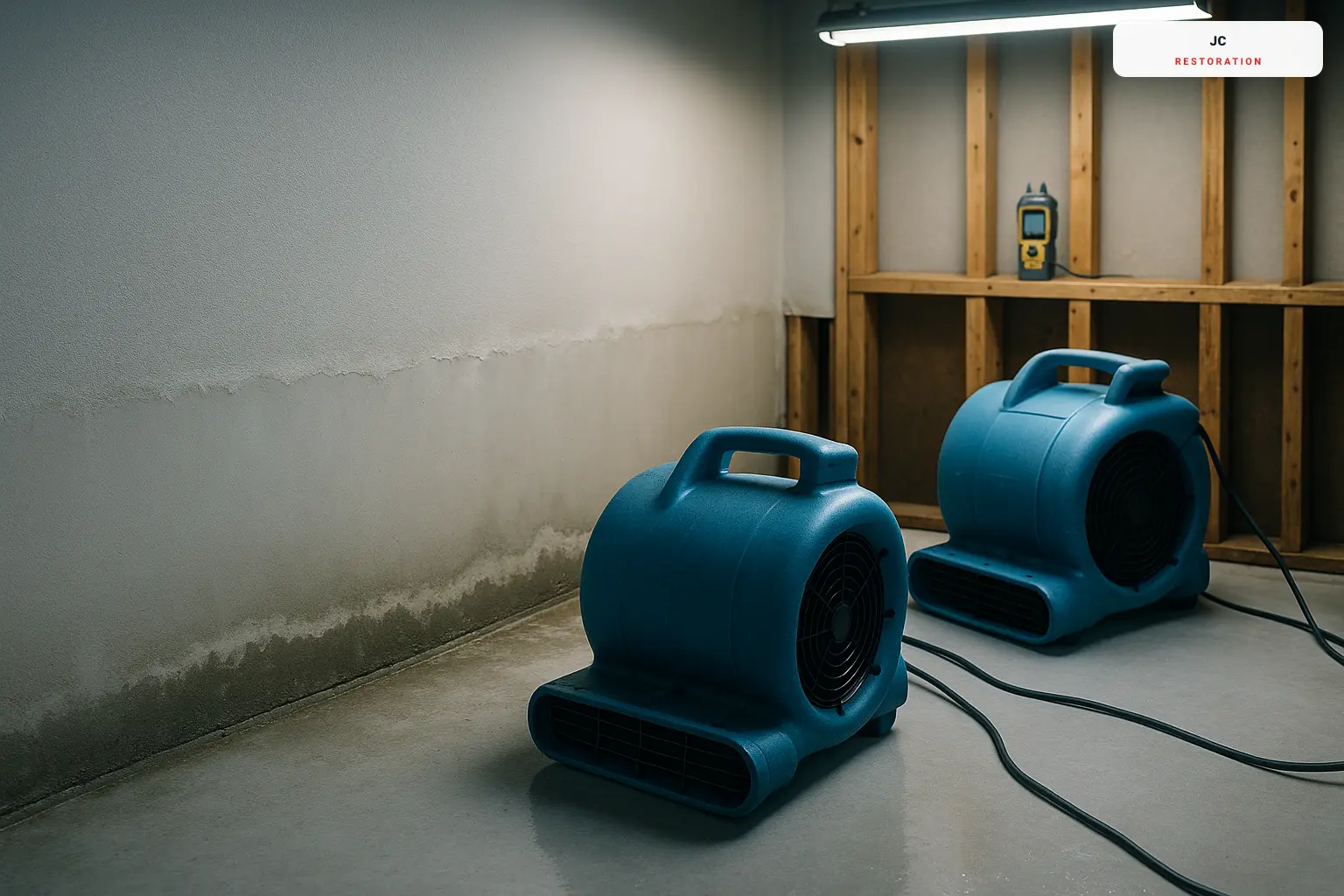
Once the truck is parked, the work follows the same pattern every time: source-control (water off, power isolated, containment up), then comprehensive documentation (photos, moisture readings, written cause-of-loss narrative), then sized equipment deployment. Daily monitoring visits with logged readings until every wet substrate returns to baseline. The reconstruction crew is the same team that did the mitigation — same phone number, same contract, same accountability through final walkthrough.

Working with adjusters on Bound Brook losses

The carrier paperwork on a Bound Brook loss starts at hour one and continues through final invoice. Daily moisture logs mapped to a building diagram, before/during/after photos of every affected surface, an Xactimate-format scope for both mitigation and reconstruction. Carrier-approved adjusters get a complete file rather than a series of follow-up requests. The cause-of-loss framing is the single most important document because it dictates which policy bucket pays and at what limits.
24/7 Emergency

Pipe burst, basement filling up, smoke damage — call our Manville dispatch now.

We dispatch a tech 24/7 across the Manville metro. Average on-site time is under an hour.

Call 908-560-5403
What We Do

Services We Offer in Bound Brook

Water Damage Restoration

24/7

Burst pipes, dishwasher leaks, water heater failures, sump backups — full mitigation through reconstruction, billed direct to your carrier.

  • 24/7 emergency dispatch
  • Truck-mounted extraction
  • Industrial drying equipment
Learn more

Fire Damage Restoration

24/7

IICRC S700 protocol applied to Somerset County fire and smoke losses. Char removal, ozone or hydroxyl odor neutralization, full reconstruction.

  • Soot + smoke odor removal
  • HVAC decontamination
  • Pack-out + content cleaning
Learn more

Storm Damage Restoration

24/7

Roof breach, blown siding, fallen-tree intrusion — emergency stabilization first, then documented mitigation, then reconstruction on one contract.

  • Emergency board-up + tarping
  • Wind-driven rain water extraction
  • Roof + envelope repair
Learn more

Mold Remediation

Negative-air containment, antimicrobial application, and porous-material removal under Somerset County conditions where summer humidity already runs high.

  • IICRC S520 protocol
  • Negative-air containment
  • HEPA filtration
Learn more

Sewage Cleanup

24/7

IICRC S500 Category-3 protocol for sewage backup events — full PPE, porous-material removal, decontamination.

  • IICRC S500 Cat-3 protocol
  • Full Tyvek + HEPA respirator PPE
  • Porous-material removal to flood line
Learn more

Reconstruction

The rebuild is where most restoration jobs slip schedule. Same-crew model means no waiting on a separate contractor to fit you in.

  • Drywall replacement + finish
  • Hardwood, LVP, tile, carpet flooring
  • Cabinetry + trim work
Learn more
FAQ

Frequently Asked Questions

If you don't see your question, just call or message us.

How do you decide what materials to remove vs save? +

IICRC S500 has clear material removal criteria based on water category and how long the material was wet. Cat-1 water + reached within 24-48 hours = often save in place. Cat-3 water = porous materials always come out. Borderline cases get the moisture-meter test: substrate that returns to dry standard with equipment runtime gets saved; substrate that stalls above dry standard for 5+ days gets removed.

What certifications do your technicians hold? +

Our crew holds IICRC certifications in Water Damage Restoration (WRT), Applied Structural Drying (ASD), and Applied Microbial Remediation (AMRT) per IICRC S500/S520 standards. Specific cert status of any technician on your job is available on request — we do not stretch certifications we do not actually hold.

Do you offer free estimates? +

For property losses (water, fire, storm, sewage), we provide a no-cost on-site assessment and an Xactimate scope of work. For non-emergency reconstruction or mold remediation we provide a written estimate after on-site evaluation. We do not give phone-quote prices for restoration work — accurate scoping requires seeing the loss in person.

What happens if mold is found during the dry-out? +

If we discover existing mold growth during a water restoration job — which happens when a slow leak was already growing mold before the recent loss — we contain that area immediately and remediate per IICRC S520 before reconstruction starts. The discovery becomes a supplemental scope item for the carrier. Done correctly, both the water loss and the pre-existing mold get resolved as one coordinated project.

How do you document moisture readings for insurance? +

We map every wet substrate on a building diagram, take initial moisture readings with calibrated meters, log readings at every daily monitoring visit, and compare against the manufacturer's dry-standard for that material. Final clearance readings show every wet substrate returned to baseline. Adjusters get the full record — building diagram, meter readings by date, equipment run logs. This is what gets the claim approved without back-and-forth.

Do you handle storm damage to roofs? +

Emergency tarping yes — we secure compromised roof openings to prevent further weather intrusion. Permanent roof replacement we coordinate with a licensed roofing contractor in our network rather than doing in-house. The water damage that follows roof intrusion is our scope; the structural roof itself is a roofer's scope. We handle the coordination so you have one project manager not two.

What is the difference between mitigation and reconstruction? +

Mitigation is the emergency phase — stopping the loss, extracting water, drying the structure, removing damaged material. Reconstruction is the rebuild — replacing drywall, installing flooring, painting, finishing. Many restorers only do mitigation and hand the rebuild to a separate general contractor, which often creates scope-coordination problems. We do both as one contract so the rebuild matches what was scoped during mitigation.

Call Now • Bound Brook

Need a Restoration Crew in Manville? Call a Live Dispatcher Right Now.

One phone call gets a truck rolling. Real Bound Brook team, real local response time, no automated phone tree. We'll be on site fast.

📞 Tap To Call 908-560-5403

24/7 Emergency Dispatch

📞 Call 908-560-5403